Thursday, October 20, 2011
Minimal eclipse period approaching
ARISSat-1 recently lapped the International Space Station and will be in a period of minimal eclipse (greater period of being in sun) starting around Nov 9 through Nov 12. Ground operators with early evening passes will have a good chance of hearing and using ARISSat-1 around this time. Operating times should be good for stations worldwide during the mid day to early evening time periods. Give it a shot and show off to some school kids while you can.


Friday, October 14, 2011
Fewer images

It appears that the current orbit of ARISSat-1 being mainly illuminated during Southern hemisphere passes has greatly reduced the number of captured images due to less participants in that part of the world . Ones that are being captured are of a lesser quality that received earlier. The orbit is slowly starting to favor afternoon and evening passes in the Northern hemisphere so we should start seeing an increase in images. This image was captured by ZS6BMN.
Thursday, September 29, 2011
Southern Hemisphere
Seems with the current orbital timing that folks in the Northern hemisphere are at a disadvantage due to the early morning passes being silent because the delay timer is not activating the transmitter until about 15 minutes after the satellite comes out of eclipse. For folks in the Southern hemisphere there are some excellent day and evening passes occurring for the next couple of weeks. Hope to see a few more images from Australia, South America, Africa and some of the equatorial regions during this time frame.
Wednesday, September 14, 2011
Couple of stunning images

I really like the Earth with Sun light glinting off the surface. The next image of the coastline is very nice as well. Congratulations to KD8CAO and SP8CGR respectively for capturing and submitting these spectacular images from ARISSat-1 over the past couple of days.
 Starting to see submissions from some new stations and hope to see even more over the next few months that ARISSat-1 is predicted to be in orbit.
Did you also know that you can get a certificate for receiveing an SSTV image from ARISSat-1? Go to the ARISSat website and look under the FAQ for "reception certificates" and follow the directions.
Tuesday, September 13, 2011
Better quality images

Now that the satellite is rotating less the images are getting much cleaner. Here is a nearly perfect copy one of the default images sent when no other images are in the queue. Congrats to JHøGEV and his station for being able to get such a clean SSTV copy from space.
Thursday, September 8, 2011
Clouds that stand out
 This image captured by KD8CAO has some really nice lighting on the clouds and seems to give it some added depth. Uploads of captured images still coming in and the gallery has received over 1,500 images since ARISSat-1 was deployed. Keep them coming!
Tuesday, September 6, 2011
Earth or moon

If this image were in black and white then I might have thought it was a shot of our moon. Thanks to JAøCAW for capturing this image on Sep 6.
Thursday, September 1, 2011
New for September
Since the number of wonderful images was getting a bit long, we started over for the month of September. The best images from August are still available by choosing "ARISSat-1_Aug_2011" under the display mission drop down menu on the main gallery page. You can always go to the archive to see everything but may need to select a higher page number for images that were published more than a few days ago. I expect September's page will be even bigger now that ARISSat-1 seems to have slowed its tumble rate and the fading is less of an impact to the images.
Monday, August 29, 2011
Amazing images still being received

I can hardly wait until some schools start trying to capture images as some great ones are being received by folks all around the globe. This image shows land mass and ocean will a few clouds and was received by IW2AGJ. Can you tell where in the world this are is located?
Thursday, August 25, 2011
Daytime imagery
 Images like this one are still being transmitted by ARISSat-1 during the day. Many midday to late afternoon passes will have several images being sent by the satellite. This image received by KD8CAO over North America has a nice sun glint effect.
Monday, August 22, 2011
 ARISSat-1 continues to operate as long as the solar panels are converting enough energy to provide operations. This image of clouds was received by VK2DAG on Aug 21.
At least one instance of a male telemetry voice was reported and this occurs when the SD card can no longer be read. The system appears to have reset after that as follow on reports indicated the system was back to the female voice.
Friday, August 19, 2011
ARISSat-1 views of the world
 I have taken a large number of the images that ARISSat-1 has captured and been received by numerous ground stations and compiled them into a "view of the world" plus a few of the other images that have been transmitted and received.
Tuesday, August 16, 2011
Battery fails; System still operates in sunlight

The ARISSat-1 website posted that the battery has not failed in a shorted state. That is good news in that it means the system can continue to operate when voltage levels from the solar panels permit. Images are still coming in but at a slower rates since the satellite does not transmit during eclipse periods. An interesting lens flare image taken by the top looking camera and was received by VU2UKT on Aug 14.
Friday, August 12, 2011
ARISSat-1 battery voltage causing resets
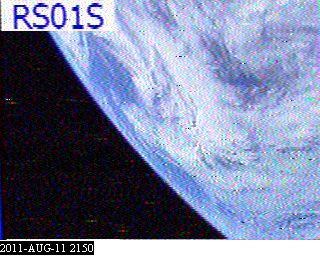
This very high quality image was received Aug 11 by ZL2BX.
The battery system on ARISSat-1 has degraded rapidly and is now dropping low enough to reset the internal control system. The system is still functional but will take longer to come up to the minimum voltage for high (or full) duty cycle operations. This will reduce your chances of hearing the satellite during the day as it may only have enough power for the low duty cycle transmission mode.
Thursday, August 11, 2011
Image sumbissions decreasing
Not sure if the novelty of images from space is wearing out or if the satellite being in low power mode a bit more often is the reason but the number of images being submitted to the http://www.amsat.org/amsat/ariss/SSTV/ site is dropping off quite a bit. Images that are not selected for publishing on the main page are still available and posted to the archives at http://www.amsat.org/amsat/ariss/SSTV/archive.php with the most recent ones on page 1 and older postings on subsequent pages.
Looking forward to seeing more images from ARISSat-1.
Looking forward to seeing more images from ARISSat-1.
Wednesday, August 10, 2011
Aug 9 image of the day

This image was received by JJøLTH while ARISSat-1 was over Asia. It appears to show some land features under and around the clouds.
Tuesday, August 9, 2011
SSTV via linear transponder
 Here is an SSTV image that was sent through the linear transponder by PA3GUO using 435.75 (LSB) for the uplink and 145.9 (LSB) on the downlink. Signals from the satellite appear to be improving as the spin rate begins to slow.
Monday, August 8, 2011
Images still coming down

 Several nice images were captured over the weekend. The first one (left) was received by JJøLTH and appears to show some land. The second one (below) was received by HA6KVC and shows another striking cloud view. The team now has a website that shows received telemetry from the satellite.
Saturday, August 6, 2011
Spectacular
 This is one of the nicest images I have seen yet. A superb shot captured by ON4CCM over Europe on Aug 6.
Friday, August 5, 2011
Red callsign image

Here is the best image I could find to date with a red callsign. I just happened to have posted the other 3 color examples previously. This image was captured by NøJY during a pass over North America on Aug 4.
Subscribe to:
Posts (Atom)